Friday, March 11, 2011

Favorite Native Plants ~ Thomas Rainer

Today's list of Favorite Native Plants comes from Thomas Rainer, a landscape architect by profession and a gardener by obsession. Thomas has worked on projects such as the U.S. Capitol grounds, the Martin Luther King, Jr. Memorial, and The New York Botanical Garden, but is happiest puttering in his small garden in Washington, D.C.

Picking my favorite natives is like picking my favorite foods: I love so many; it’s hard to know where to begin. But I think I’ll focus on a few underappreciated natives that make great garden plants. 

Most gardens have shade and these areas are typically the areas of our garden we neglect the most, or fill with invasive groundcovers. My absolute favorite fern is Dryopteris x australis or Dixie Wood Fern. This plant is a naturally occurring hybrid that is found in moist areas from Louisiana all the way to Virginia. The plant has strikingly upright fronds that grow three to four feet in height. What I love about this plant is how vigorous it is. In places where Ostrich Fern or Cinnamon Fern have limped along, Dixie Wood fern thrives, covering the ground in dense, glossy foliage. Plus, this fern is semi-evergreen, holding much of its form during winter. Combine this fern with other perennials with contrasting foliage such as hostas, Solomon’s Seals, or native sedges. You won’t be disappointed.

My favorite grass at the moment is Sporobolus heterolepsis or Prairie Dropseed (click here for photo). This plant is finally getting the attention it deserves. Low, neat clumps of fine textured grass hug the ground for most of the growing season. During late summer, the grass adds fine inflorescences that smell a bit like coriander (or burnt popcorn). The grass has lovely orange tones in during autumn. I love to use this plant in large masses, particularly against the edge of a lawn where it gives the look of a ‘rough.’ And because this plant is so low and fine-textured, it is an excellent plant to interplant flowering perennials into. A lovely, drought-tolerant, and tough grass. Chanticleer has a large mass of this grass at the edge of a large lawn . . . it’s stunning. 

Finally, last year I fell in love with Monarda punctata or Horsemint. This low perennial sports hot pink whorled leaves just below the flowers that dries into a lovely silver color that glows in the moonlight. Unlike most Monardas, this plant tolerates poor soil and drought. Pollinators love this plant. Since this plant can get a bit gangly by itself, I plant it in pockets on the edge of the border, or better, interplanted into a matrix of low grasses like Sporobolus, Schizachyrium, or Elymus. Last year, I easily grew this plant from seed and it bloomed during the first season. 

You can read more of Thomas' views on gardening and landscapes on his blog, Grounded Design

Thursday, March 10, 2011

Favorite Native Plants ~ Kathy Jentz, editor of Washington Gardener Magazine

Last month I started a little series of "Favorite Native Plant" posts, reaching out into the local gardening community to discover what native species are favorites. Since many of us are in the planning phase of our gardens for the coming season, I thought I would continue the series.

Today's favorites are from Kathy Jentz, editor, publisher and founder of Washington Gardener magazine.


My three favorite native plants  

It'd have to be Virginia Bluebells for sheer beauty. They are just stunning and photos never seem to really capture it. Worth the hike to see them in our local parks along stream bed valleys. En masse near Carderock Falls is my favorite Bluebell-peeping location.  

For all around best in show, my favorite is the Serviceberry. Whether you call it Shadbush or Saskatoon, this small tree hits on all top plant attributes. It has seasonal interest, glorious spring flowers, attracts wildlife, easy to grow, and the berries are not just edible - they are, in fact, downright yummy.  

Finally, I adore Beautyberry. It really comes into its own in late Fall when much of the rest of our gardens are growing weary and wan. Did you know it is also a mosquito repellent? If they are bugging you on a hot summer day, grab a few green leaves off the Beautyberry, crush them, and rub them on your wrists plus ankles.

Thanks Kathy. Beautyberry is one of my favorites, too, just because of the abundance of wildlife that it attracts.

Wednesday, March 9, 2011

New controversary about invasive species?

I was wondering why I was seeing so many articles about exotic and invasive species recently and then I discovered that last week was National Invasive Species Awareness Week.

The articles that I have seen floating around on local blogs and garden discussion groups seem to be slanted towards the opinion that exotic species might not be quite as bad as they were once thought.

A contributor to the WashingtonGardener Yahoo group mentioned Mark A. Davis's new book, Invasion Biology, in which he states that invasive species might actually be getting a bad rap.

Davis certainly doesn't say that ALL invasive species are okay. But he does say that if an exotic species is “not causing significant harm,” then “altering one’s perspective is certainly much less costly than any other sort of management program. ”

In my mind, Davis's highly controversial opinion does make sense. There seems to be a tendency to assume that all exotic, non-native species are bad and that all native species are better.

Much of this is, of course, a matter of semantics. Many people seem to interchange the words exotic and invasive and, of course, all exotic species are NOT invasive and some are even considered beneficial by many (did you know that many species of honeybees are non-native?)

According to the USDA National Invasive Species Information Center, an invasive species is defined as:

1) non-native (or alien) to the ecosystem under consideration and 

2) whose introduction causes or is likely to cause economic or environmental harm or harm to human health.

By this definition, the fact that a plant or animal is alien (exotic) does not, by itself, make the organism invasive.

According to another website, over 85% of exotic species are NOT invasive.

Continuing the discussion on the Yahoo group, trumpet vine was mentioned as being both Native and Invasive. Again, this is a matter of semantics.

The NC State University website states that:

Native plants are never invasive. The term invasive applies only to exotic plants and not to native plants; invasive implies a negative effect on native plants and animals. On the other hand, native plants that establish quickly in your garden and spread readily are more appropriately termed “aggressive”.

The same website goes on to provide this statement:

There are many exotic plants that do not become invasive, and many can safely be planted in your landscape. However, it takes scientists many years or even decades to fully understand an exotic plant's potential invasiveness. New information is being gathered, and you should check with your local nature center, botanical garden, or Cooperative Extension agent to find out about a plant's invasiveness before introducing it to your property. 

We can easilly heed that advice by referring to these local lists of problematic invasive species in Maryland and Virginia.

Invasive Species of Concern in Maryland

Invasive Alien Plant Species of Virginia (pdf file)

Another term to add to the discussion is the word "noxious", which I found on a National Park Service website. 

Noxious Weeds.  The term noxious is a legal designation used specifically for plant species that have been determined to be major pests of agricultural ecosystems and are subject, by law, to certain restrictions. The U.S. Department of Agriculture regulates noxious weeds. Plants can also be designated as "noxious weeds" by states and counties, usually through "noxious weed boards". Many noxious weeds are designated for their impacts to agriculture also threaten natural areas.

You can refer to this USDA page to find plants listed as Noxious Weeds in your state: State Noxious Weed Lists

Grants for gardening

Scott's Miracle-Gro, the World’s Largest Lawn and Garden Company, wants to help communities to Cultivate Green Thumbs

With that in mind, Scott's has launched their new GRO1000 Grant Program, offering $1,500 grants to deserving communities and organizations in the hopes it will get people involved in creating more community gardens and green spaces where they call home.

The goal: to plant 1,000 gardens and green spaces across the U.S., Canada and Europe by 2018.

“Something happens when communities grow and learn together,” said Jim King, ScottsMiracle-Gro’s senior vice president of corporate affairs. “People develop a sense of pride and accomplishment when they get involved in cleaning up their neighborhoods, growing flowers, or cultivating their own healthy local food, and we want to help them get the job done.”

Communities interested in pursuing 2011 GRO1000 grassroots grants can apply online at http://thescottsmiraclegrocompany.com/GRO1000 by March 31, 2011. Projects should include the involvement of neighborhood residents and foster a sense of community spirit.

The U.S. Environmental Protection Agency (EPA) is accepting grant applications for $1.9 million in funding for environmental education projects and programs. The purpose of the grants is to promote environmental stewardship and help develop knowledgeable and responsible students, teachers and citizens. EPA expects to award at least 20 grants nationwide ranging from a minimum of $15,000 to a maximum of $100,000 and will accept applications until May 2, 2011.

The grants provide financial support for innovative projects that design, demonstrate, and/or disseminate environmental education practices, methods, or techniques. Projects should involve environmental education activities that go beyond disseminating information.

The Environmental Education Grant Program provides funding to local education agencies, state education or environmental agencies, colleges or universities, not-for-profit organizations, or noncommercial educational broadcasting entities. Tribal education agencies, which are controlled by an Indian tribe, band or nation, may also apply, including a school or community college.

Since the program began, EPA has provided more than $50 million in funding to approximately 3,000 agencies and organizations.

More information on eligibility and application materials:
http://www.epa.gov/edcuation/grants.html

Monday, March 7, 2011

Encourage Kids to Weed Out Hate

I recently wrote a post called Zen and the Art of Landscape Maintenance which talked about how relaxing and rewarding the act of weeding by hand can be.

But fellow gardener Marc Daniels has taken the therapeutic value of weeding a step further. In his Weed Out Hate campaign, Marc suggests that we should teach young children the challenges of weeding by hand as a lesson in weeding out hatred in the world. Highlighted text is from the Weed out Hate website.

Give them a head start by moistening the soil and using a trowel to loosen the root structure. Allow them to tug on the weed. Show them how weed-extracting aids work and inspire them to try to duplicate the functionality with their fingers. In this manner, they not only learn how embedded the roots of prejudice really are, but how much concentration and stamina it requires to properly extract them. 

The kindergardening concept was created in in Germany by Pedagogue Friedrich Wilhelm August Froebel in the 19th century as a means to an ends—a method for exercising a child’s spirit as well as the mind and body. Most of us are unaware that the word kindergarten means kindergardening and not just pre-school with recess. The Weed Out Hate Initiative works because it provides needed exercise for our children. Additionally, it enables them to root out weeds throughout the school landscape, and, in the process, teaches a valuable lesson about weeding out bias and prejudice.

Daniel's Weed Out Hate campaign encourages children to email President Obama and voice their support for a White House Peace Seed Planting on August 28, 2011 - the 48th anniversary of Dr. Martin Luther King, Jr's famous "I have a dream speech."

Join the cause and help Weed Out Hate 

Some forty seven years after Dr. Martin Luther King, Jr. gave his “I Have a Dream” speech to the nation, much of his “promised land” vision has come to fruition. Unfortunately, there are still persistent weed seeds of hate that remain embedded in our collective consciousness, hindering our success as individuals and as a society. 

Let’s Finish with Our Hands what Dr. King Started with His Heart and Soul.

We, the kindergardeners of America, desire to complete the job that Dr. King started. Just as weeds compete for nutrients and water that cultivated garden plants require, our inner weed seeds, the germs of prejudice and hate, prevent us from experiencing our deepest root-connections to nature. With the right intention, removing weeds from our yards and gardens can serve as a paradigm for eradicating the inner weeds of hate and prejudice that many of us harbor and too often suppress. The physical act of weeding,therefore, enables us individually and collectively to realize Dr. King’s dream for a world free of hate and prejudice for one and all. 

Your Voices Can and Will Be Heard.

Just a few generations ago, teachers from all over the country asked their students to write President Nixon, asking him to remove phosphates from detergents. This grassroots campaign displayed the power of children’s voices in formulating policy. E-mail President Obama today and voice your support for a White House Peace Seed planting on August 28th, 2011, the 48th anniversary of Dr. King’s famous “I Have a Dream” speech.

For more information, visit: Weed Out Hate

This is such a clever campaign that I wanted to pass it on. I hope you will too!

Friday, March 4, 2011

Volunteers needed to help remove invasive species

Local reader Anne B. sent an email message after my post about local tree planting and asked if I knew of any plans to remove kudzu and ivy that are "choking" many of the trees in the area.

In response, here is a list of invasive weed removal activities which are planned. Volunteers are welcome to participate!  

Sunday, March 13 from 10 a.m. to 1 p.m. - Invasive Weed Removal at Scott’s Cove, 10964 Harding Road, Laurel  

Saturday, March 19 from 9 a.m. to Noon - Invasive Weed Removal at Brighton Dam, 2 Brighton Dam Road, Brookeville  

Sunday, March 20 from 9 a.m. to Noon - Invasive Weed Removal and Tree Planting at Pigtail Recreation Area, 5400 Green Bridge Road, Dayton  

Saturday, March 26 from 9 a.m. to Noon at the Patuxent next to WSSC’s Office, 14501 Sweitzer Lane, Laurel  

Sunday, April 10 from 9 a.m. to Noon - Invasive Weed Removal at Brown’s Bridge Recreation, 2220 Ednor Road, Silver Spring  

Saturday, April 16 from 9 a.m. to Noon - Invasive Weed Removal at Scott’s Cove, 10964 Harding Road, Laurel, MD 

For more information, contact Kimberly Knox - 301-206-8233 or email kKnox@wsscwater.com  

More local groups that have invasive plant removal volunteer opportunities:

Thursday, March 3, 2011

Nothing corny about this weed killer

When I was a child, my grandmother grew huge fields of corn out in Oklahoma. I'd like to think that if she were alive today, she would be using her corn for something really environmentally friendly like bio-fuel or corn-gluten weed control.

Fortunately, other folks are out there putting corn to these great eco-friendly uses.

Safer Brand (a leader in organic gardening solutions) has introduced corn-based Concern Weed Prevention Plus, an all-natural weed control solution that is not only up to 90% effective on dandelions and crabgrass in the very first year, but will not leave harmful residuals in your lawn. Powered by corn gluten meal, Concern® Weed Prevention Plus® comes in a 25 pound bag providing you with 1500 sq. ft of natural weed prevention. Concern Weed Prevention Plus contains no synthetic ingredients and unlike traditional synthetic formulas, your children and pets can play on the lawn immediately after application. The product's corn-gluten meal formulation results in pellets that evenly distribute nutrients and kill weeds without burning grass or fragile plants.

I haven't tried this product yet myself but if I get tired of pulling my weeds by hand, I might just give it a try.

For more information, read: New Use for Corn: Weed Control

Wednesday, March 2, 2011

Tree Planting - March 12, 9am - Noon

Help plant trees for wildlife with WSSC and local Girl Scouts.

Washington Suburban Sanitary Commission is having a tree planting on Saturday, March 12 from 9 a.m. to Noon at Scott’s Cove, 10904 Harding Road, Laurel, MD.

WSSC will be partnering with Girl Scouts to plant sassafras, elderberry and black cherry trees and will provide the gloves and the shovels.

The reason that WSSC choose these Mid-Atlantic trees is due to the wildlife benefits of these trees for wild turkeys, pileated woodpeckers, thrushes and northern mockingbirds.

Monday, February 28, 2011

Peanut Shaped Community Garden coming to DC

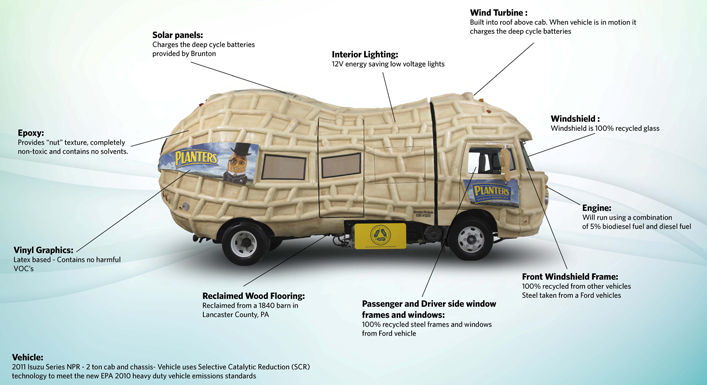
I’ve seen several articles about the new eco-friendly Nutmobile in the news recently and I didn’t pay much attention until I saw that the legume shaped low-rider will be bringing a new peanut shaped community garden to DC.

Here are excerpts from an article by Leslie Guevarra on greenbiz.com. Click here to read Leslie's article.


With the help of The Corps Network and neighborhood volunteers, Planters plans to turn disused plots of land in New Orleans, Washington, D.C., San Francisco and New York City into peanut-shaped community greenspaces.  

The Planters Groves, designed by landscape architect Ken Smith, will feature native trees and plants as well as benches and other amenities made from reclaimed building materials in an eco campaign that includes the rollout of the company's latest Nutmobile, which now runs on biodiesel and sports solar panels and a wind turbine.  

The efforts, part of a promotion the company is calling "The Naturally Remarkable Tour," blend urban revitalization, conservation and volunteerism with whimsy to create what Planters hopes will be engaging community projects that serve as living lessons in sustainability.  

Though designed by Smith, funded by Planters and coordinated with The Corps Network, each grove is to be built and maintained by local volunteers and neighborhood groups.  

"We want to let people know what it's like to be a planter," said Jason Levine, senior director of marketing for Planters. The initiative is based on a concept that's core to the company — peanut crops help replenish the earth — and underscores the firm's sustainability efforts, he said.  

Sites are being scouted for the groves in Washington, D.C., San Francisco and New York City. 

"These will be great places for communities to get back to nature and experience the outdoors," Levine said.

The New Orleans grove is expected to be complete by late March, with all four groves complete by the end of the year, Jones said. The Planters "Naturally Remarkable Tour" will thread its way from project city to project city with the new Nutmobile in the vanguard.


Read more: http://www.greenbiz.com/news/2011/02/23/mr-peanuts-plan-help-build-greener-communities#ixzz1EtKeuYmq

Saturday, February 26, 2011

Don't let the bugs bug you


Dealing with insects in the landscape is sometimes a challenge for the eco-friendly gardener.

Many people who really love the outdoors are still unreasonably "bugged" by bugs. And although  biting insects can certainly make outdoor activities unpleasant, most other garden insects are relatively harmless and some are even beneficial insects.

Keeping your plants healthy and inviting wildlife to your yard are two good environmental choices for cutting down on insect problems. Healthy plants can usually fend off damage from insects, and birds and other forms of predatory wildlife help by eating what they can catch.

Remember, anything that you decide to spray to kill insects has the potential of making its way into local water supplies. Also, most pesticides are indiscriminate—they may take care of your pest but they also kill all the good insects that help your garden function.

However, if you still feel that a perfect environment is an insect free environment, keep these principles in mind:
  • Some of the insects that you may be eliminating are actually beneficial to your plants and the environment. For example, caterpillars turn into pollinating butterflies and ladybugs eat other leaf chewing insects. Try to identify the insects before you eliminate them.  There are several websites listed below to help with insect ID.
  • Spot treat when and where you see insect damage. Don't spray your whole yard thinking you will keep insects away. Most pesticides don't work as repellents.
  • Practice Integrated Pest Management- Integrated pest management (IPM) is a wholistic approach to pest control. It integrates chemical, cultural (cultivating, weeding, mulching), and biological pest control techniques to reduce the pest population and keep damage to an acceptable level.
  • Many insects can actually be controlled by handpicking, pruning or spraying with water.
  • Ask for safer alternatives to traditional, chemical pesticides at your local garden center. These include insecticidal soaps, horticultural oils and products containing a bacterium called Bacillus thuringiensis (BT).
For more information:
For help identifying insects:

Website by Water Words That Work LLC