Monday, February 28, 2011

Peanut Shaped Community Garden coming to DC

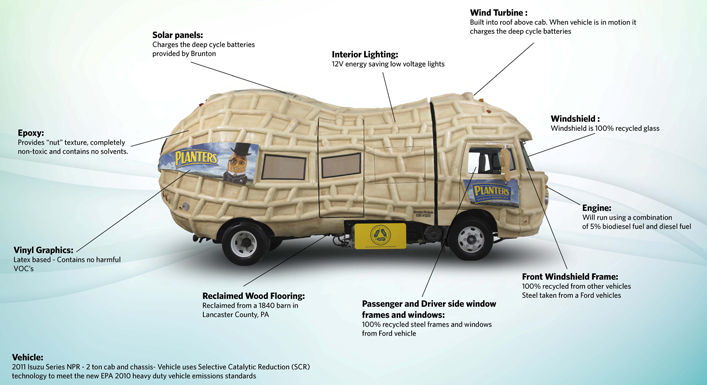
I’ve seen several articles about the new eco-friendly Nutmobile in the news recently and I didn’t pay much attention until I saw that the legume shaped low-rider will be bringing a new peanut shaped community garden to DC.

Here are excerpts from an article by Leslie Guevarra on greenbiz.com. Click here to read Leslie's article.


With the help of The Corps Network and neighborhood volunteers, Planters plans to turn disused plots of land in New Orleans, Washington, D.C., San Francisco and New York City into peanut-shaped community greenspaces.  

The Planters Groves, designed by landscape architect Ken Smith, will feature native trees and plants as well as benches and other amenities made from reclaimed building materials in an eco campaign that includes the rollout of the company's latest Nutmobile, which now runs on biodiesel and sports solar panels and a wind turbine.  

The efforts, part of a promotion the company is calling "The Naturally Remarkable Tour," blend urban revitalization, conservation and volunteerism with whimsy to create what Planters hopes will be engaging community projects that serve as living lessons in sustainability.  

Though designed by Smith, funded by Planters and coordinated with The Corps Network, each grove is to be built and maintained by local volunteers and neighborhood groups.  

"We want to let people know what it's like to be a planter," said Jason Levine, senior director of marketing for Planters. The initiative is based on a concept that's core to the company — peanut crops help replenish the earth — and underscores the firm's sustainability efforts, he said.  

Sites are being scouted for the groves in Washington, D.C., San Francisco and New York City. 

"These will be great places for communities to get back to nature and experience the outdoors," Levine said.

The New Orleans grove is expected to be complete by late March, with all four groves complete by the end of the year, Jones said. The Planters "Naturally Remarkable Tour" will thread its way from project city to project city with the new Nutmobile in the vanguard.


Read more: http://www.greenbiz.com/news/2011/02/23/mr-peanuts-plan-help-build-greener-communities#ixzz1EtKeuYmq

Saturday, February 26, 2011

Don't let the bugs bug you


Dealing with insects in the landscape is sometimes a challenge for the eco-friendly gardener.

Many people who really love the outdoors are still unreasonably "bugged" by bugs. And although  biting insects can certainly make outdoor activities unpleasant, most other garden insects are relatively harmless and some are even beneficial insects.

Keeping your plants healthy and inviting wildlife to your yard are two good environmental choices for cutting down on insect problems. Healthy plants can usually fend off damage from insects, and birds and other forms of predatory wildlife help by eating what they can catch.

Remember, anything that you decide to spray to kill insects has the potential of making its way into local water supplies. Also, most pesticides are indiscriminate—they may take care of your pest but they also kill all the good insects that help your garden function.

However, if you still feel that a perfect environment is an insect free environment, keep these principles in mind:
  • Some of the insects that you may be eliminating are actually beneficial to your plants and the environment. For example, caterpillars turn into pollinating butterflies and ladybugs eat other leaf chewing insects. Try to identify the insects before you eliminate them.  There are several websites listed below to help with insect ID.
  • Spot treat when and where you see insect damage. Don't spray your whole yard thinking you will keep insects away. Most pesticides don't work as repellents.
  • Practice Integrated Pest Management- Integrated pest management (IPM) is a wholistic approach to pest control. It integrates chemical, cultural (cultivating, weeding, mulching), and biological pest control techniques to reduce the pest population and keep damage to an acceptable level.
  • Many insects can actually be controlled by handpicking, pruning or spraying with water.
  • Ask for safer alternatives to traditional, chemical pesticides at your local garden center. These include insecticidal soaps, horticultural oils and products containing a bacterium called Bacillus thuringiensis (BT).
For more information:
For help identifying insects:

Friday, February 25, 2011

DC Schoolyard Greening Meeting, Mar. 2

DC Schoolyard Greening will hold their first meeting of the year on March 2 at 4:30 pm at the DDOE Headquarters.

DC Schoolyard Greening (DCSG) was formed in May of 2003 by a group of local and national non-profit organizations, city government agencies, teachers, and concerned individuals.  In 2006, it became a program of the DC Environmental Education Consortium.

DCSG's mission is to increase and improve schoolyard green spaces to promote ecological literacy and environmental stewardship among students, teachers, school staff, parents, and the surrounding community.

For more information,  feel free to contact Josh Volinsky, volinsky@earthday.net or Trinh Doan, 202-535-1653.

Thursday, February 24, 2011

Zen and the Art of Landscape Maintenance

“If we could see the miracle of a single flower clearly, our whole life would change.”
~ Buddha

Most people today seem to be constantly busy --constantly rushing from one place to another -- constantly texting or talking on cell phones or checking the internet or listening to music.

The big problem with that, for me anyway, is that my mind doesn’t have the chance to just open up and think. I’m assaulting it with so much activity, that there are no empty spaces in there for original thoughts or discovery or enlightenment.

I’ve read quite a few self-help and philosophy books in my life and many of them say that you should learn to meditate--that you should set aside time and clear your mind and not focus on anything, except perhaps your breathing. You should try to attain what is called “zen mind”. I just can’t do it. I never have been able to. Either my mind just continues to race or I fall asleep, trying.

That is, until I step into my garden. There is just something about working outside in nature that gets me more in touch with my inner thoughts. The deeper my hands dig into the soil, the deeper my thoughts seem to become.

One of my favorite activities for deep thought in the garden is hand-pulling weeds. Manually pulling weeds is one of the best forms of organic weed control. It's easy to do, doesn't pollute the environment, and its free!

When I weed, I go out into my yard, sit down on the grass, sometimes on a towel or a short stool, take a deep breath, and using a weeding fork or trowel, I start removing weeds.

When I find a weed, I grab the plant close to the ground, insert my weeding fork or other tool into the soil and gently loosen the roots of the weed and remove the plant.

I’m careful not to dig too deep so I don’t disturb the roots of any nearby plants or bring deeply buried weed seeds up closer to the surface where they could sprout.

As long as the weeds don’t have any seeds on them, I pile them up to toss into my compost pile.

I’m not sure why this process is so relaxing. Perhaps its because it takes enough concentration to keep my mind from wandering anywhere else. I have to focus on finding the weeds and digging down deep enough to get all of the root. And it takes just the right amount of pressure. Pulling too hard will tear the leaves off the plant, leaving the roots behind. But it is also a rather mindless activity, leaving me time to concentrate on the other sights and sounds around me. And then every now and then, out of no where, some really deep thought will pop into my mind.

It makes me wonder if Buddha, the original “father” of Zen thinking, spent much time in a garden.

Back around 500 B.C., Siddhartha Gautama (also known as Buddha) set out to achieve enlightenment. It took him years of struggle, but he finally realized that “everything changes, nothing remains unchanged”. His conclusion from all of this was that the only thing that is really important in life is the joy and pleasure and experience we receive from each passing moment.

Unhappiness, Buddha decided, is a result of attachment to specific things or circumstances which, by their very nature, are impermanent. “By ridding oneself of these attachments, one can be free of suffering.” This is the basis of Zen and somehow, to me, it all seems very relevant to gardening.

We all have certain attachments to ideas about what our gardens should be. And then along comes the weather (freezing temperatures, drought), financial restraints, homeowners regulations and other things that can interfere with our grand schemes – like weeds. What’s a gardener to do?

Perhaps the secret is to adopt some Zen thinking for our gardens. No matter what we plant or how much money and time we spend in the garden, none of it is permanent. Instead of measuring our gardens in the number of beautiful blooms and fruit-bearing plants, perhaps we should measure the success of our gardens in the number of enjoyable moments we spend there.

Certainly there is no pleasure in dousing weeds with broad spectrum herbicides, polluting the planet as you go. But to gently reach down into the earth and pull these stray plants free, listening and watching and inhaling all of the sights and sounds and smells around you….those are the moments that can turn landscape maintenance into landscape magic.

Perhaps that is what Buddha was doing when he said:

“When you realize how perfect everything is you will tilt your head back and laugh at the sky” ~ Buddha

Wednesday, February 23, 2011

Favorite Native Plants ~ Alison Gillespie


For number three in my series of favorite native plants, I asked Alison Gillespie, a local naturalist, writer and avid gardener. Although I have followed Alison's blogs for some time, I was still pleasantly surprised by the eloquence and beauty of her response to my question about natives.

Alison lives and writes about gardening and the environment from her home in Silver Spring, Maryland. She specializes in making small urban lots more livable for both people and wildlife, and sometimes coaches others through the process as well.  

Wintering Over: A few native plants Can Feed Your Soul, and the Birds 
by Alison Gillespie

I really love winter.  People are always surprised to find that out, especially if they know me through gardening circles. 

But I actually think that it’s the gardener in me that needs winter.  I need the break, the slow down, the empty browns and grays that fill those empty lots along Metro’s tracks.  Winter, I think, is the positive image that reflects summer’s intensity. 

Maybe it’s the intensity of my gardening passion that makes me love the break so much; when I read those articles about gardeners who brag of living in warmer climes where they can garden 12 months a year it just makes me tired, not jealous.  There’s also a refreshing sense of having one’s palette cleaned each winter, as the flowers fade away.  Garden mistakes and misfortunes fade from memory like vegetable peelings in the big black bin out back. 

But I also believe that my love of native plants contributes to my contented winter feelings.  If I lived in the city without a garden, I’d probably be miserable.  But this morning, for example, I awoke to cold, clear, sunny skies and found mockingbirds feasting on bright winterberries outside the kitchen window.  The color, the animation of the birds, and the contrast of reds, blues and gray-browns made my heart sing and not a single guilty feeling about weeding entered my brain.  With coffee and a warm robe I was thankful for the garden and enjoyed the view.  This, I thought out loud, is what makes living close-in with a tiny city lot area bearable.

There are lots and lots of native plants that urban gardeners can use to add color to a winter landscape.  Most are so carefree that you can plant them and almost forget about them.  Winterberries (Ilex verticillata), like many shrubs, are one of those natives.   Deciduous cousins to the better known American hollies, they are nondescript during the warmer months, although their small leaves and tiny, fragrant, white blossoms attract loads of bees.  In the fall, the leaves give way to stems spackled with bright red berries which are often imitated by plastic wreath makers at Christmas time;  there are so many berries on each branch that you can’t even see the woody stem underneath.  Then, at the end of winter, the berries prove irresistible to many species of native birds, who arrive to gulp them down one by one and strip those branches bare.

This winter I have also been enjoying the stand of switchgrass (Panicum virgatum) which has finally matured in my garden.  I scooped up three of the variety known as Heavy Metal  for a very cheap price from a clearance shelf last winter at the local garden center.  It was a risk – they were hastily planted last December at the back of the garden, shortly before the huge blizzards dumped so much snow upon us all here in DC. 

My risk was rewarded this fall, when I realized how often my eye was drawn to the gentle swaying of the grass stems.  Now the birds have arrived to feast on the seeds, and I realize I’m not the only one whose been watching and waiting. 

The birds are also drawn to my  brown, dried up swamp sunflowers (Helianthus angustifolius).  Don’t let the name scare you – you need not have a swamp to get luscious yellow blossoms from this beautiful native perennial.  It will do just fine in average soil, although I think this plant particularly likes it near downspouts in urban yards.  You also need a lot of vertical space for them, since their stems can sometimes reach eight feet or more in height. 

In our yard, the swamp sunflowers were allowed to stay all winter, even though they turned brown and made enormous arcs across the areas which held our tomatoes last summer, and now the juncos seem to find their seeds yummy.  Many afternoons when the sun weakly surrenders to the cold and dark, the birds are out there in a flocks, hopping around like miniature penguins and beep-beep-beeping to each other in gossipy tones. 

Inside, we watch and make plans for long games of chess and cocoa, and curl up with seed catalogs.  Our palettes have been cleansed, our souls refreshed.  We dream of rolling up sleeves and churning compost, and immerse ourselves in delirious fantasies that this year’s garden will surely be the best ever.  In winter it all still seems very possible.

Thanks, Alison, for sharing such a wonderful post with our readers.

If you would like to read more of Alison's work, you can visit her blogs: Where You Are Planted and Sligo Naturalist

Tuesday, February 22, 2011

Favorite Native Plants ~ Steve Bates


This is the second in my series of favorite native plants of local gardeners. Today's choices are from Steve Bates, a longtime gardener and journalist and author of The Seeds of Spring: Lessons from the Garden.     Steve grew up in the Virginia suburbs of Washington, D.C., where he still lives.  He has won numerous awards for his writing and spent 14 years as a reporter and editor at The Washington Post.  
Steve's Favorite Natives

Virginia has a wide range of native plants, which isn’t surprising, given the fact that it has such a wide variety of garden settings. We have sandy coastal areas, rolling piedmont and some mini-mountains, at least by Colorado standards. But my favorite native plants are the ones that can take some shade, given that I’ve never owned or rented a house with a sunny side yard or back yard big enough for a decent-sized display of annual and perennial plants.

My favorite has to be the Virginia bluebell (Mertensia virginica). I have a few in my back yard, or at least, I did. Their foliage hasn’t shown up yet, and the foliage doesn’t tend to stick around long after they finish blooming in the spring. So they are kind of a phantom plant. But I trust they are coming.

The buds start out almost pink, and even at peak their shade of blue is not as deep as some of the more prized blue flowers you can buy. Also, they arrive at a time—April—when many other showy plants are at their peak. But when they are in full bloom, naturalized in a wooded area—often near water—they can be breathtaking.

No matter how busy I am, I try every spring to take a walk along Goose Creek, near my home in Loudoun County, and enjoy their short-lived splendor. You can see them in other parks in Northern Virginia, and even from the Washington and Old Dominion trail if you know where to look. But the (well-hidden) hiking path that connects Goose Creek, a scenic waterway in its own right, with the Potomac River is a terrific one. The path begins near the ruins of an old stone bridge, and it slides northward in an easy one-hour hike. If your timing is right, every time you take a turn in the path, you come upon a patch of bluebells even better than the last one. Somehow, I always forget to take my camera….

I’m very fond of mountain laurel and rhododendron, also native Virginia plants. But you sort of drop them in the ground and run, so there’s not much mystery or work involved.

Butterfly weed is a nice, colorful addition to a sunny garden spot. And you can’t go wrong with black-eyed susans. Still, if I could grow or simply enjoy only one native Virginia plant, it would be the bluebell.
Thanks, Steve, for sharing your thoughts.  

To read more about Steve's gardening experiences, look for  The Seeds of Spring, which  follows the challenges, failures, joys and revelations that Steve experiences as he cultivates vegetables, fruit and flowers in a remarkable setting.

The book intertwines practical, “how-to” gardening advice with deep insights as Steve recognizes the richness and simplicity of the outdoor life and the importance of sustainability for individuals and the planet. The Seeds of Spring takes the reader beyond the ordinary, revealing the extraordinary in everyday activities amid the all-too-familiar setting of suburban sprawl.

Monday, February 21, 2011

Favorite Native Plants ~ Nature Friendly Gardener Marlene A. Condon

Native plants are wonderful additions to eco-friendly landscapes for many reasons. But which natives are right for you and your gardens? I decided to poll the local gardening community for some of their favorite native plant species to help you decide.

Today's choices are from Marlene A. Condon. Marlene is a nature writer and the author of The Nature-friendly Garden (see note below). She lives in Crozet, Virginia, where her yard has been showcased on Virginia public television.

Marlene's Favorite Natives 

My most favorite plant is the Trumpet Creeper vine, Campsis radicans. It's one of the most used-by-wildlife native plants I can think of even though it gets bad press as being "invasive". However, all outdoor gardening involves pulling out unwanted plants (I don't like the term "weeds") and in a nature-friendly yard, Trumpet Creeper is not that much of a problem.

That's because so many animals make use of its seeds and thus limit how many are available to germinate the next spring. Mammals such as Gray Squirrels feed on them from early fall to winter and birds such as Tufted Titmice, Dark-eyed Juncos, and American Goldfinches take them in winter. Sphinx Moths feed at the flowers and I have found caterpillars feeding on the seeds inside the pod in the fall (I haven't been able to identify the caterpillars yet). Many species of ants either get sap directly from the plant by chewing open a tiny spot or indirectly by tending aphids and feeding on their honeydew. 

The Sourwood tree (Oxydendron arborium) is another favorite of mine. It's lovely in the spring when it's covered with white flowers that the Ruby-throated Hummingbird and numerous species of insects feed at. In the fall, the leaves on this smallish tree turn a lovely red or maroon and still looks as if it's in bloom with its noticeable seed capsules. From fall into winter, squirrels and juncos feed on the seeds. 

And you can't beat the attractiveness of the Monarda genus of flowers for people and wildlife alike. Lilac-colored Wild Bergamot blooms (Monarda fistulosa) feed butterflies, bees, and numerous other insects. The red-colored Bee Balm (Monarda didyma) is very attractive to hummingbirds. And these plants are one of the few kinds that the White-tailed Deer does not eat.

As a fellow wildlife gardener, I can appreciate all of Marlene's choices. I was mesmerized watching a ruby throated hummingbird push itself almost all the way into trumpet vine flowers one day.

Marlene is offering copies of her book, The Nature-friendly Garden: Creating a Backyard Haven for Plants, Wildlife, and People (Stackpole Books), to readers of the Metro DC Lawn and Garden blog at a special discount. For an inscribed and autographed copy of her book at a special price of $10.00 plus shipping ($4.00) , please visit her web site at www.marlenecondon.com to contact her. Be sure to mention the Metro DC Blog to receive the discount.


Thanks Marlene! And happy gardening.

Saturday, February 19, 2011

Gardeners' Sustainable Living Project

The Gardeners' Sustainable Living Project was created by Jan Huston Doble on her beautiful garden blog Thanks for Today as a way for gardeners to share ways that they are actively practicing a greener lifestyle and contributing to protecting our environment.

If you are a gardener, garden blogger, garden writer, or garden merchandiser, Jan invites you to join in and share what you do to help, rather than hinder, nature.

"Just because we are gardeners doesn't mean we're operating 'sustainably'," Jan says. "Let's find ways to garden by taking into account our impact on the environment and whether that has a positive effect on our health and that of Mother Earth."

In Mid March Jan will encourage gardeners to write blog posts and leave comments regarding their sustainability efforts at home and in the garden. She asks you to tell what YOU do, or plan to change, about the way you live and garden.

According to Jan, "you do NOT need to be 'green' to join in--just interested and aware of our environment and willing to look at what you can do to contribute positively and eliminate or reduce unnecessary actions."

For more information about how you can participate, read Jan's post on the Sustainable Living Project.

Friday, February 18, 2011

Does eco-friendly gardening help local wildlife populations?

As a critter lover, I am a big fan of eco-friendly gardening. Eliminating chemicals, protecting the groundwater  and using native plants are all beneficial to local wildlife. When you make these changes, it doesn’t take long to see an increase in the number of butterflies, birds, bees, hummingbirds, dragonflies and other garden visitors in your landscapes.

Participating in wildlife monitoring programs, such as the Great Backyard Bird Count, may  help prove these eco-friendly benefits to others.

Various  programs around the country encourage wildlife lovers  to help monitor local wildlife.  Participants in these counts are called  ‘citizen scientists’, and  their contributions are invaluable in the study of wildlife  populations and migration trends. Some even feel that data from ‘citizen scientists’ is helping researchers to investigate far-reaching questions such as the impacts of West Nile virus, global warming, and acid rain.

These programs are open to anyone with an interest in wildlife. In most cases, the only skill required is the ability to count! They are a great opportunity to get outside with your family and explore the creatures that find their way into your landscape.

Digital cameras are excellent tools for the budding ‘citizen scientist’ or backyard naturalist. Pictures of birds, butterflies and other forms of wildlife can be used in researching a species in books or on the internet.

If you think you find something truly unique, such as a bird or insect that you have never seen before, don’t be reluctant to ask the experts. You never know what discoveries you might find, or what difference you might be making to the environment, right from the comfort of your own backyard.

No matter what sort of wildlife you find interesting, there is probably a monitoring program that will encourage you to study it a little closer. Here are some local and national programs to get you started on your journey to becoming a "citizen scientist":

The Virginia Frog and Toad Calling Survey  is conducted by a group of volunteers from across the Commonwealth who spend three nights a year surveying various wetland habitats for frogs and toads. The survey involves listening and then identifying the various species by their call, and recording the approximate number of individuals.

Loudon Wildlife Conservancy has several wildlife monitoring programs, including stream monitoring, bluebird nestbox monitoring, amphibian monitoring and an annual butterfly count.

Virginia Department of Game and Inland Fisheries,  Wildlife Mapping  is an outreach program that allows school children, citizens, community groups, and other city, county and state organizations to collect wildlife-related information that will be available to everyone. The program provides an opportunity for students and volunteers to perform field studies that contribute to the state's biological databases.

 The Great Backyard Bird Count, The Christmas Bird Count and Project FeederWatch are all studies compiled primarily from information provided by individual citizens. These studies, which are joint programs between Audubon and the Cornell Lab of Ornithology, involve citizens across the country counting birds on specific days and reporting their findings. Once the results are tallied, they are analyzed by scientists and posted online.

North American Butterfly Association – A membership-based not-for-profit organization working to increase public enjoyment and conservation of butterflies, the NABA  conducts an annual butterfly count to provide important information about the geographic distribution and population sizes of various butterfly species.

Monarch Watch – An educational outreach program based at the University of Kansas that engages citizen scientists in large-scale research projects.

Monarch Larva Monitoring Program – The Monarch Larva Monitoring Project (MLMP) is a citizen science project involving volunteers from across the United States and Canada in monarch research. It was developed by researchers at the University of Minnesota to collect long-term data on larval monarch populations and milkweed habitat.

Operation RubyThroat– Started by South Carolina resident Bill Hilton Jr, this cross-disciplinary international initiative utilizes citizen scientists to study behavior and distribution of the Ruby-throated Hummingbird.

Wildlife Watch –Participants in Wildlife Watch share sightings of wildlife and plants where they live. National Wildlife Federation and their Wildlife Watch partners collect and review findings so that they can track the behavior and health of wildlife and plant species nationwide.

Journey North: A Global Study of Wildlife Migration and Seasonal Change – Geared primarily towards students from K-12 grade, this organization engages participants to track the coming of spring through the migration patterns of monarch butterflies, bald eagles, robins, hummingbirds, whooping cranes — and other birds and mammals; the budding of plants; changing sunlight; and other natural events.

Thursday, February 17, 2011

Great Backyard Birdcount Starts Feb 18th

robins

Put out the birdseed and grab your binoculars. The Great Backyard Bird Count (GBBC) starts tomorrow!

Once I started gardening for wildlife, I was quick to go from casual birdwatcher to full-fledged critter loving nature nerd. In fact, right now I have my thrift-store baby monitor turned on and placed outside my window so I can enjoy the sound of the robins on my birdbath.

I also have my bird guide and binoculars ready so that I can start counting birds tomorrow for the 2011 Great Backyard Bird Count.

What is the Great Backyard Bird Count?

The Great Backyard Bird Count is an annual four-day event led by the Cornell Lab of Ornithology that encourages bird watchers to count their backyard birds and report their findings on-line. This year, the GBBC runs from February 18th – 21st.

Although it may sound silly to count your backyard birds, these counts are very useful in helping scientists learn where birds are across the continent and to see how populations compare with previous years. This helps to determine how things like development, pollution and weather may be affecting various species.

Anyone can participate, from beginning bird watchers to experts and you can count for as long as you want each day of the event. It’s free, fun, and easy—and it helps the birds.

If you want to participate, here are the quick and easy steps from the GBBC website:  

1. Plan to count birds for at least 15 minutes on one or more days of the count. You can count for longer than that if you wish! Count birds in as many places and on as many days as you like—one day, two days, or all four days. Submit a separate checklist for each new day. You can also submit more than one checklist per day if you count in other locations on that day.  

2. Count the greatest number of individuals of each species that you see together at any one time. You may find it helpful to print out your regional bird checklist to get an idea of the kinds of birds you're likely to see in your area in February. You could take note of the highest number of each species you see on this checklist.  

3. When you're finished, enter your results through GBBC's web page. You'll see a button marked "Enter Your Checklists!" on the website home page beginning on the first day of the count. It will remain active until the deadline for data submission on March 1st.

As the count progresses, anyone with Internet access can explore the results from their own towns or anywhere in the United States and Canada. They can also see how this year's numbers compare with those from previous years. Participants may also send in photographs of the birds they see. A selection of images is posted in the online photo gallery.

I always think its fun to go back and read the results of previous counts.

You can search by state. Here are the five highest counted species from 2010 for DC, Maryland and Virginia

DC: American Robin – 737; House Sparrow – 396; European Starling – 317

Maryland: Canada Goose – 38,118; Snow Goose – 20,317; Common Grackle – 18,240

Virginia: Common Grackle – 25,421; Dark-eyed Junco – 20,005; Red-winged Blackbird – 19,446

Or you can search by species

American Robin – 737 in DC; 5,489 in Maryland and 13,311 in Virginia

For more detailed information, visit the GBBC website or download this pdf file of instructions.

Website by Water Words That Work LLC