Spring is an ideal time to plant trees and Casey Trees offers rebates up to $100 per tree to individuals who plant trees on private property — residential or commercial — in the District.
Small and medium canopy trees — including standard-size fruit and trees — are eligible for rebates up to $50 per tree, as long as the tree reaches 15 feet tall and wide at maturity. Seven genera and 27 species noted for their large canopy and environmental benefits qualify for rebates up to $100 per tree. There is no limit to the number of rebates per property.
Invasive tree species and any species of ash, dwarf trees and shrubs do not qualify for a rebate of any amount.
To help customers identify rebate-eligible tree stock, many D.C.-area nurseries and home improvement centers are promoting the program in their stores with promotional signage and special tree tags. However, trees may be purchased from any store and through landscaping and landscape architecture companies.
The Tree Rebate program is funded by the District Department of the Environment.
Downloadable rebate forms, submission instructions and a complete list of trees eligible for the increased rebate are available at www.caseytrees.org/rebate.

Showing posts with label casey trees. Show all posts
Showing posts with label casey trees. Show all posts
Wednesday, March 14, 2012

Friday, January 13, 2012
Favorite Trees – Casey Trees Staff members answer the question “why”
 Ask someone if they have a favorite tree, and many are quick to name a particular species. It often takes a little more “digging” to come up with the answer to “why”. But since digging is one of my favorite things to do, I decided to ask around. I started with some of the staff at Casey Trees.
 If you don’t know about Casey Trees, they are a D.C.-based non-profit group committed to restoring, enhancing and protecting the tree canopy of D.C. They plant trees, teach other people about trees, and work with elected officials, developers, and community groups to make sure that the population of trees in D.C. continues to grow forth and multiply. Ten years and over 10,000 trees since their beginning, it’s obvious to see that they DEFINITELY “dig” trees.
Jared Powell, Director of Communications and Development for Casey Trees helped me poll a few of their staff members to get some answers to the question “What is your favorite tree, and why?” Their answers reflect childhood memories, aesthetic admiration and respect for the environment that help to explain why Casey Trees is so devoted to helping Washington DC remain “The City of Trees.”
Native trees, which are generally better suited for the local environment, are marked with an (N)
Jared’s favorite tree: The eucalyptus, while not native to North America, has certainly made itself at home along the west coast particularly in California where I am from. Growing up, I would build forts at the base of these giants using its tessellated bark for roof materials, soak up its sweet scent emitted from its distinctive long, blue leaves and lounge in its shade on hot summer days. In short, the eucalyptus tree reminds me of home and a time when my only worry was when the end of recess bell would ring.
Marty O’Brien, COO: When I was growing up in Minneapolis in the late 1970s, there were many big and beautiful elm trees lining the boulevards in our neighborhood and throughout the city. At some point the city came through and marked many trees with an orange “X” and soon removed all of those trees. It drastically changed the character of the neighborhood and the city for the worse so, at about 10 years old, I realized for the first time the impact that trees could have. We didn’t know what we had until it was gone. So that is why I chose the American elm (N) as my favorite tree. It was the first real connection I had with trees.
Mark DeSantis, Development Associate: It’s not just the bursts of golden yellow leaves that dot D.C.’s streets during the fall that make the ginkgo my favorite tree – though in my opinion there are few things more beautiful to see in this city. For me it’s more their history and the fact that they’ve been around for so long that fascinate me. They are truly a relic from the past that has survived for so long – something few things in this world have managed. It’s this uniqueness that I find beautiful.
Oliver Pattison, Communications Associate: I am a fan of the pin oak (N) because it is a great large-canopy street tree with a significant presence along certain D.C. streets. I know that oaks are not everyone’s favorite type of city tree because of concerns about falling acorns, but they more than make up for it with their beautiful fall foliage. I discovered that I liked pin oaks in particular by walking around Mount Pleasant and Kalorama Park in the fall.
Christopher Horn, Communications Associate: There are many species of oak in my home state of Kansas, but none like the willow oak (N). When I moved to D.C., I was not only amazed at how many trees there were, but also by the uniqueness of the willow oak. The tree has a dense canopy and its oblong willow-like leaves go from a bright green in spring to a beautiful yellow-orange in the fall. The willow oak is a sight to see in any season.
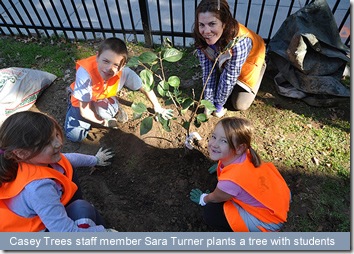
Sara Turner, Urban Forestry Manager: The artist in me loves sassafras (N) for its color and three distinct leaf shapes, some simple others lobed, which make this tree's identification fun. I especially love the one shaped like a mitten resembling the state of Michigan, where I studied woody plants. In the fall, the leaves transition to striking hues of orange, red, and yellow. I am easily charmed by the spotting of Sassafras on a fall hike.
Lisa Morris, Planning and Design Associate: Allentown, PA, where I’m from, has beautiful sycamore (N) lined streets where the branches form an almost solid mass. These giant trees framed the streets I grew up on.
Michael Potts, GIS Specialist: The blackjack oak (N) is a small, scrubby survivor, though one can grow very large if given proper resources. There are some small specimens at the top of Sugarloaf Mountain in Maryland, but I first came upon them as they grow natively on my family’s ranch in Texas. I loved taking walks through the forest populated by blackjacks and post oaks. They always had a rugged appeal to me.
Tom Buckley, Director of Technical Services and Research: Having a favorite tree is a little like having a favorite ice cream. I don’t think about it much. But the Baobabs in Zimbabwe surprised me, as a little kid on safari. You could crawl around inside them. I had a tree-house, but this was a tree that could actually house you. And they grew very large in dusty, dry climates.
Rather than choosing one favorite tree, Shawn Walker, Urban Forestry Instructor, described the importance of following the practice of right plant/right place. In my opinion, right plant/right place is even more important than choosing natives. Choosing trees that are suitable for your property’s site conditions will generally require less water and less harmful chemicals – both of which are great for the local environment.
Shawn Walker: I chose “right tree, right place” because it’s kind of a theme around here: for a planted tree to thrive one must consider the site-specific constraints and chose a species thus suited – ‘right tree, right place’. When I came to work at Casey Trees a year ago, I was surprised that no other staff had chosen this as their favorite, so I nabbed it right away!
‘Right tree, right place’ describes a thoughtful approach to tree selection and landscape design but it also reminds us that there is room for our attitudes towards trees to be more nuanced, something more than simply ‘I like/dislike that tree’. Take the argument about native versus non-native species, for instance. I used to staunchly believe that native species should always be planted when possible. However, as I have become more aware of the threats to our urban forest from climate change and exotic pests, this bias has become somewhat murky.
Our international trade patterns have resulted in the introduction of numerous harmful tree pests from Asia, and their potency as pests results from the fact that they are new invaders in a new land with few, if any, natural enemies to keep them in check. Of course, we should do what we can to control pests like the Emerald Ash Borer that continues its wholesale ash-murdering rampage but we can also take measures to make our urban forests more resistant to Asian pests by including Asian tree species within our palette. The Manchurian Ash (Fraxinus mandschurica), to site a specific example, coevolved and shares native habitat with the Emerald Ash Borer, and it just so happens that it has a high degree of resistance to the pest. If we love ash trees and want to include them in our species composition, should we not consider the Manchurian Ash as one of many arrows in our quiver? Thus continues the ‘right tree, right place’ discussion…
Now that we’ve started digging, how about you. Do you have any favorite trees?
Wednesday, October 26, 2011
Are you tired of the rich getting all of the gold? It's time to occupy "fall" street

There is plenty of fall foliage in Washington DC, Maryland and Virginia to go around. So take some time this weekend to “go for the gold”. Take a tour around DC, visit a park or take a little drive to one of the other great locations for Fall Foliage in Washington DC, Maryland and Virginia that I found on dc.about.com
Before you head out, I encourage you to read the post (with gorgeous photos) on Casey Trees blog, which lists some trees to look out for, including:
- American beech trees (Fagus grandifolia) - at the U.S. Capitol grounds, Dumbarton Oaks and along the Capital Crescent trail.
- Red maples (Acer rubrum) - in front of the Smithsonian National Museum of the American Indian and on the White House grounds.
- Sweetgum (Liquidambar styraciflua) - Check it out near the Vietnam Veterans Memorial, at the National Zoo and in West Potomac Park.
- White oak (Quercus alba) - The white oak can be found all over D.C., including at Dumbarton Oaks, Tudor Place, Logan Circle, Cedar Hill and the Capital Crescent Trail. Most white oak leaves turn red, but some turn a gorgeously rare deep-wine.
- Sourwood (Oxydendrum arboreum) - Find these simple oval-leafed trees at Glenwood Cemetery and the U.S. Botanic Garden on Maryland Ave SW.
Now don’t despair. You, too, can grow your own gold! October – December are great times to plant trees, since they enter their dormancy during this period. And best of all, there are rebate and incentive programs to help cover the costs of tree planting in your Metro DC yard.
Casey Trees and the DDOE now offer rebates of up to $100 for having qualified trees planted in your landscape.
Montgomery County Maryland’s website lists rebates of up to $150 per tree ($600 per lot) for residents who plant trees.
There is a coupon for $25.00 off the purchase price of a tree on the Marylanders Plant Trees website.
So get started on your own tree-rich landscape. Just make sure that you are committed to the regular investments of time and care needed to watch your new treasure grow!
Saturday, January 29, 2011
Casey Trees Launches Arbor Kids
Casey Trees’ has launched a new webpage, Arbor Kids to get kids outdoors to learn about trees and their many environmental, social and economic benefits.
Although created for kids, Arbor Kids is a great resource for educators, caregivers and parents, too.
About Casey Trees:
Casey Trees is a Washington, DC-based not-fot-profit, established in 2001, dedicated to restoring, enhancing and protecting the tree canopy of the Nation's Capital.
For more information, visit www.caseytrees.org.
Although created for kids, Arbor Kids is a great resource for educators, caregivers and parents, too.
Downloadable activities include:
- Name that Tree! Learn how to identify some of the most commonly found trees in the District.
- Tree Benefits Scavenger Hunt. Challenge yourself and friends to find all the listed tree benefits in the shortest amount of time.
- How Tall Is That Tree? In four easy steps, you can determine the height of any tree.
- My Trees: A Home Inventory. Name, count and map the trees at and in front of your home.
Schools and other learning centers can also request a tree planting through Casey Trees’ Community Tree Planting program. Casey Trees provides the trees, tools and technical assistance free of charge. Students participate in a tree rally and follow up care activities, complementing existing classroom instruction.
For more information, visit the Casey Trees website.About Casey Trees:
Casey Trees is a Washington, DC-based not-fot-profit, established in 2001, dedicated to restoring, enhancing and protecting the tree canopy of the Nation's Capital.
For more information, visit www.caseytrees.org.
Subscribe to:
Posts (Atom)