Friday, January 20, 2012

Number one reason to plant trees: Hummingbirds Love Them

hummertrees

I’ve been running a poll on this blog and on our Facebook page, asking why people plant trees. To go along with it, I started a post this morning listing the benefits of trees. Well, the list just kept growing and growing and growing so I haven’t gotten it finished just yet.

In the meantime, I wanted to share one of the main reasons I love trees – they attract hummingbirds!

People sometimes ask me how they can attract hummingbirds to their property and I often mention that they should plant a tree. Yes, hummingbirds are attracted to certain tree species that have nectar flowers, but they also love having trees that provide them with a place that they can sit and keep an eye on their “domain”. Hummingbirds are very territorial and they love to sit in a tree and overlook the other hummingbird plants in your garden or the feeders that you place out for them. As soon as they see a rival hummingbird appear, they will immediately swoop down and chase them away, and then return to their perch in the tree.

They also eat gnats and other small insects that fly around trees and certain species have been known to eat sap that oozes  from holes created in trees by woodpeckers and sapsuckers. Hummingbirds also typically nest in trees.

The first time I saw a hummingbird sitting in one of our oak trees, I was in complete awe. And I have to admit that I spent a good part of that summer moving a ten foot ladder around my yard and taking thousands of photos of those little guys.

So, the number one reason that I will ALWAYS recommend that people plant trees is, hummingbirds love them!

Gardening for Hummingbirds

Plants to Attract Hummingbirds

Wednesday, January 18, 2012

“America’s Great Outdoors” starts in your own backyard

The America’s Great Outdoors Initiative was established by President Obama in April at a White House Conference to start a “National Conversation” to gather input for projects to help reconnect Americans, especially children, with nature.

The Secretaries of the Interior and Agriculture, Administrator of the Environmental Protection Agency and Chair of the Council on Environmental Quality were asked by the President to host 12 -20 “listening sessions” around the country to hear from people and groups involved in conservation and recreation efforts and programs. The topic was: how do we get more people outside, involved with nature.

In addition to the formal and informal listening sessions (some of them were online chats), comments, stories and ideas were collected through the America’s Great Outdoors Initiative webpage on the Interior Department’s website: http://americasgreatoutdoors.gov/

Anyway, as soon as I heard about the Initiative, I started inundating the website (listed above), their Facebook page, and their online chats. What were my ideas? Basically, that connecting people with nature doesn’t necessarily mean taking a trip to a park somewhere. Nature starts right outside our back doors, in our gardens.

Well, the results of all of their surveys and data collection were recently released in a 111 page report: America’s Great Outdoors: A Promise to Future Generations February 2012. I haven’t read the whole thing yet, but what I have read has inspired and enthused me. I wish I could print the whole thing here, but I encourage you to download a copy for yourself and give it a read.

Below are some excerpts of the report:

  • “America’s Great Outdoors begins when you open your front door and step outside— whether it is onto an urban stoop, a suburban sidewalk or a rural front porch. Before we can reach the National Parks, Trails, or Wilderness Areas, we enter into our neighborhoods, downtowns, community gardens and parks. Appreciating the Great Outdoors means exploring the places where we live, work and play; the places that define the human environment. By first cultivating a sense of stewardship in our communities, we encourage stewardship of cultural and natural resources beyond our immediate surroundings.”(Written comment from website)
  • “We need a philosophical change of what the great outdoors is. We don’t need to go out west or to some faraway place. It can be a little stream, out your door, even if it’s in the city. It exists where we exist.” (Listening Session Participant, Hyde Park, NY )
  • Many people articulated a need to redefine the “great outdoors” to include iconic national parks and forests, wildlife refuges, and cultural and historic sites, as well as neighborhood and city parks, community gardens, and school yards.
  • AGO (America’s Great Outdoors) seeks to empower all Americans—citizens, young people,and representatives of community groups; the private sector; nonprofit organizations; and local, state, and tribal governments—to share in the responsibility to conserve, restore, and provide better access to our lands and waters in order to leave a healthy, vibrant outdoor legacy for generations yet to come.
  • Americans communicated clearly that they care deeply about our outdoor heritage, want to enjoy and protect it, and are willing to take collective responsibility to protect it for their children and grandchildren. In fact, they are already doing so. They are restoring rivers and streams, building and improving hiking trails and bike paths, ensuring the long-term conservation of their private lands, sponsoring beach and roadside cleanups, planting trees and gardens, and restoring migratory bird habitat and populations.

What’s really great about this whole project is that we, the citizens of this country, were asked our opinions about what needs to be done to reconnect people with nature. And from our answers, action is being taken to help make a positive difference. You can see a list of some of the projects that are being implemented across the country in response to the input from the Great Outdoors Initiative by visiting this website: Rivers, Trails and Conservation Assistance Program. Projects include:

  • Interfaith-Intercommunity Nature Gardens in Washington DC - Work with partners to develop a “toolkit” for greater Washington, D.C. houses of faith that will help create a multi-denomination Sacred “Green Corridor” in the greater Washington, D.C. area.
  • Patuxent Tidewater Conservation Plan in Maryland - A regional landscape conservation plan for Southern Maryland guiding land conservation efforts of the Patuxent Tidewater Land Trust and encouraging collaborative initiatives with local public and private partners.
  • Groundwork Richmond - Develop plans for adaptive reuse of Richmond brownfield sites that support environmental restoration, neighborhood revitalization, youth engagement, and urban park development goals.

Monday, January 16, 2012

Go Green on Martin Luther King Day

Martin Luther King was a man who dedicated his life to standing up for the projects in which he believed. And Lisa P. Jackson, on the EPA website, reminds us that Martin Luther King day is a great day to volunteer for the projects that we believe in and want to support.
“Everybody can be great. Because anybody can serve.” Those words from Dr. Martin Luther King, Jr. have inspired millions of Americans over the years to step up and serve. And they’re the words that come to mind each January, when we honor Dr. King’s legacy on the Martin Luther King Jr. Day of Service. Each year, people across the country come together for volunteer service, to strengthen their communities and make a difference for the people around them.
The Martin Luther King website that Ms. Jackson mentioned allows you to put in your zip code and locate volunteer activities in your area. There are plenty of opportunities to find a project to help you answer the question that MLK once posed: "Life's most persistent and urgent question is: 'What are you doing for others?'"

If you can't find a project that compels you to participate, Ms. Jackson has several suggestions for making a "green" difference on a personal level.
There are countless ways to be part of a Green MLK Day: Start using biodegradable and environmentally friendly cleaning products. Learn about composting and give it a shot in your own backyard. Pick up litter at a local park or field. Organize a “green club” in your workplace, school or community.
There are many more suggestions for going green on this blog, including eliminating chemicals, creating compost, and installing rain barrels. You can use the search tab at the top of this page to find a great green option to get you started or check out a post such as this one on Bare Naked Gardening, that sums many of them up in one place.

Whatever you decide to do on this day of remembrance, Jackson encourages you to share your project on twitter with the hashtag #greenMLK

Right Tree, Right Place Workshop

Virginia Cooperative Extension, Master Gardeners of Northern Virginia and Arlington-Alexandria Tree Stewards will present a forum on “Right Tree in the Right Place: Selecting, Planting and Maintaining Trees and Shrubs” on Wednesday, Jan. 25 at 6:30 p.m. at the Fairlington Community Center.

The program is free. For information, call (703) 228-6414

Event Location: Fairlington Community Center
3308 South Stafford Street
Arlington, VA 22206
Contact Name: Master Garden Helpdesk
Contact E-mail: mgarlalex@gmail
Contact Phone: 703-228-6414

Friday, January 13, 2012

Global Warming? Blame it on termite farts

My friend Sidney emailed me a cute article she found online about a speech a young girl named Sophie Paterson from  New Zealand made about farts. (see copy below) The article is getting passed (no pun intended)  around the internet quite a bit, mostly because no matter how mature or sophisticated we think we are, farts still make us titter.

So, of course, I had to try to find a way to fit it into my eco-friendly blog, and here it is:

According to Ms. Paterson's essay, termites are number one on the list of top farters. AND, according to the EPA website, termite farts are the second largest natural source of methane emissions.

Termites. Global emissions of methane due to termites are estimated to be between 2 and 22 Tg per year, making them the second largest natural source of methane emissions. Methane is produced in termites as part of their normal digestive process, and the amount generated varies among different species. Ultimately, emissions from termites depend largely on the population of these insects, which can also vary significantly among different regions of the world.
And methane is one of the contributing factors to global warming.

So quit blaming the cows, sheep and elephants for all of that errant methane. Blame it on the termites.

Favorite Trees – Casey Trees Staff members answer the question “why”

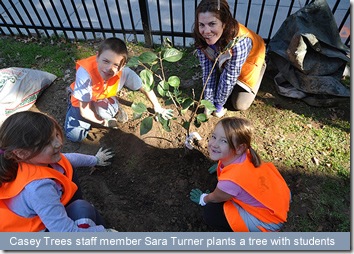
caseytrees2 Ask someone if they have a favorite tree, and many are quick to name a particular species. It often takes a little more “digging” to come up with the answer to “why”.  But since digging is one of my favorite things to do, I decided to ask around. I started with some of the staff at Casey Trees.

If you don’t know about Casey Trees, they are a  D.C.-based non-profit group  committed to restoring, enhancing and protecting the tree canopy of D.C. They plant trees,  teach other people about trees,  and work with elected officials, developers, and community groups to make sure that the population of trees in D.C. continues to grow forth and multiply. Ten years and over 10,000 trees since their beginning, it’s obvious to see that they DEFINITELY “dig” trees.

Jared Powell, Director of Communications and Development for Casey Trees helped me poll a few of their staff members to get some answers to the question “What is your favorite tree, and why?” Their answers reflect childhood memories, aesthetic admiration and respect for the environment that help to explain why Casey Trees is so devoted to helping Washington DC remain “The City of Trees.”

Native trees, which are generally better suited for the local environment, are marked with an (N)

Jared’s favorite tree: The eucalyptus, while not native to North America, has certainly made itself at home along the west coast particularly in California where I am from. Growing up, I would build forts at the base of these giants using its tessellated bark for roof materials, soak up its sweet scent emitted from its distinctive long, blue leaves and lounge in its shade on hot summer days. In short, the eucalyptus tree reminds me of home and a time when my only worry was when the end of recess bell would ring.

Marty O’Brien, COO: When I was growing up in Minneapolis in the late 1970s, there were many big and beautiful elm trees lining the boulevards in our neighborhood and throughout the city.  At some point the city came through and marked many trees with an orange “X” and soon removed all of those trees.  It drastically changed the character of the neighborhood and the city for the worse so, at about 10 years old, I realized for the first time the impact that trees could have.  We didn’t know what we had until it was gone.  So that is why I chose the American elm (N) as my favorite tree.  It was the first real connection I had with trees.

Mark DeSantis, Development Associate:  It’s not just the bursts of golden yellow leaves that dot D.C.’s streets during the fall that make the ginkgo my favorite tree – though in my opinion there are few things more beautiful to see in this city. For me it’s more their history and the fact that they’ve been around for so long that fascinate me. They are truly a relic from the past that has survived for so long – something few things in this world have managed. It’s this uniqueness that I find beautiful.

Oliver Pattison, Communications Associate: I am a fan of the pin oak (N)  because it is a great large-canopy street tree with a significant presence along certain D.C. streets. I know that oaks are not everyone’s favorite type of city tree because of concerns about falling acorns, but they more than make up for it with their beautiful fall foliage. I discovered that I liked pin oaks in particular by walking around Mount Pleasant and Kalorama Park in the fall.

Christopher Horn, Communications Associate: There are many species of oak in my home state of Kansas, but none like the willow oak (N). When I moved to D.C., I was not only amazed at how many trees there were, but also by the uniqueness of the willow oak. The tree has a dense canopy and its oblong willow-like leaves go from a bright green in spring to a beautiful yellow-orange in the fall. The willow oak is a sight to see in any season.

Sara Turner, Urban Forestry Manager: The artist in me loves sassafras (N)  for its color and three distinct leaf shapes, some simple others lobed, which make this tree's identification fun. I especially love the one shaped like a mitten resembling the state of Michigan, where I studied woody plants. In the fall, the leaves transition to striking hues of orange, red, and yellow. I am easily charmed by the spotting of Sassafras on a fall hike. 

Lisa Morris, Planning and Design Associate: Allentown, PA, where I’m from, has beautiful sycamore (N)  lined streets where the branches form an almost solid mass. These giant trees framed the streets I grew up on.

Michael Potts, GIS Specialist: The blackjack oak (N)  is a small, scrubby survivor, though one can grow very large if given proper resources. There are some small specimens at the top of Sugarloaf Mountain in Maryland, but I first came upon them as they grow natively on my family’s ranch in Texas. I loved taking walks through the forest populated by blackjacks and  post oaks. They always had a rugged appeal to me.

Tom Buckley, Director of Technical Services and Research: Having a favorite tree is a little like having a favorite ice cream.  I don’t think about it much.  But the Baobabs in Zimbabwe surprised me, as a little kid on safari.  You could crawl around inside them.  I had a tree-house, but this was a tree that could actually house you.  And they grew very large in dusty, dry climates

Rather than choosing one favorite tree, Shawn Walker, Urban Forestry Instructor, described the importance of following the practice of right plant/right place. In my opinion, right plant/right place is even more important than choosing natives. Choosing trees that are suitable for your property’s site conditions will generally require less water and less harmful chemicals – both of which are great for the local environment.

Shawn Walker: I chose “right tree, right place” because it’s kind of a theme around here: for a planted tree to thrive one must consider the site-specific constraints and chose a species thus suited – ‘right tree, right place’. When I came to work at Casey Trees a year ago, I was surprised that no other staff had chosen this as their favorite, so I nabbed it right away!

‘Right tree, right place’ describes a thoughtful approach to tree selection and landscape design but it also reminds us that there is room for our attitudes towards trees to be more nuanced, something more than simply ‘I like/dislike that tree’. Take the argument about native versus non-native species, for instance. I used to staunchly believe that native species should always be planted when possible. However, as I have become more aware of the threats to our urban forest from climate change and exotic pests, this bias has become somewhat murky. 

Our international trade patterns have resulted in the introduction of numerous harmful tree pests from Asia, and their potency as pests results from the fact that they are new invaders in a new land with few, if any, natural enemies to keep them in check. Of course, we should do what we can to control pests like the Emerald Ash Borer that continues its wholesale ash-murdering rampage but we can also take measures to make our urban forests more resistant to Asian pests by including Asian tree species within our palette.  The Manchurian Ash (Fraxinus mandschurica), to site a specific example, coevolved and shares native habitat with the Emerald Ash Borer, and it just so happens that it has a high degree of resistance to the pest. If we love ash trees and want to include them in our species composition, should we not consider the Manchurian Ash as one of many arrows in our quiver? Thus continues the ‘right tree, right place’ discussion…

Now that we’ve started digging, how about you. Do you have any favorite trees?

Thursday, January 12, 2012

Wood Ashes in the Garden: Good or Bad?

One of the things I love the most about cooler weather is the nice cozy fires that my husband builds in our fireplace and outdoor fire pit. Whether it’s because he is a Sagittarius (one of the fire signs of the zodiac) or just because he grew up in a campfire loving family, Tom starts building fires as soon as the temperatures begin to fall.

Needless to say, we end up with a LOT of wood ashes. The first time I cleaned out our fireplace (over ten years ago now) I piled huge buckets full of ashes into our compost pile. It just seemed somehow logical to me, putting decomposed wood back into the earth. Tom, my green-gardening guru hubby, just shook his head. Then he told me to get a shovel and he helped me dig them all back out and put them in a metal container so we could better control their use in our landscape.

I wasn’t WRONG about the nutritional value of wood ashes. The truth is that wood ashes contain most of the 13 essential nutrients that soil must supply for plant growth. The secret is just to make sure that you utilize those nutrients ONLY as needed.

When applied directly to garden soil, wood ashes will raise the pH level. This is great if the pH level of your soil is low. Not so great if the pH level of your soil is already high. In fact, over applying wood ash can cause serious imbalances in your soil.

The pH value is a measure of a soils acidity or alkalinity and directly affects the ability of plants to utilize the nutrients available to them. The pH scale ranges from 0 to 14, with 7 as neutral. Numbers less than 7 indicate acidity while numbers greater than 7 indicate alkalinity.

So how do you determine the pH value of your soil? You get your soil tested.  Getting your soil tested is an excellent way to help minimize the use of chemicals in your yard. Knowing what your yard needs allows you add only what is necessary, eliminating the possiblity of harming your yard or causing excess nutrients to find their way into our waterways.

If the pH level of your soil is low, then adding wood ash may be beneficial. Again, this depends on what you want to grow. Wood ash is beneficial to most garden plants except acid-loving plants such as blueberries, rhododendrons and azaleas.

Here are a few more facts about wood ashes, I found from searching usasearch.gov:

The value of wood ash depends on the type of wood you burn. Harwood ash has a higher percentage of nutrients than ash from softwoods.

Lawns that need lime and potassium can also benefit from wood ash but you should apply no more than 10 to 15 pounds of ash per 1,000 square feet of lawn and only every couple of years.

Wood ash is alkaline, which means you should use precautions when handling it.
  • Wear eye protection, gloves and a dust mask.
  • Do not scatter ashes in the wind.
  • Do not use ash from burning trash, cardboard, coal or pressure-treated, painted or stained wood. These materials can contain potentially harmful substances. For example, the glue in cardboard boxes and paper bags contains boron, an element that can inhibit plant growth at excessive levels.
  • Never leave wood ash in lumps or piles. If it is concentrated in one place, excessive salt from the ash can leach into the soil and create a harmful environment for plants.
  • Do not apply ash at time of seeding. Ash contains too many salts for seedlings.
Source: Wood Ashes Can Benefit Gardens and Lawns

Why do you love trees?

Trees. What's not to love. They give you shade, fruit, flowers, fragrance, firewood and so many other great things. So I'll be focusing on trees and the people who love them in my next few posts. In the mean time, why do you love trees? Answer our poll or use the comments section to add an answer of your own.

What is or would be your primary motivator for planting a tree in your yard?

Tuesday, January 10, 2012

Help Kickstart the Meadow Project

meadowproject I am so inspired by visionary garden writers who work so hard to influence others about eco-friendly gardening practices. I know, first hand, how difficult it can be to both garden AND write with the goal of encouraging others to take a little bit better care of the planet.

That’s why I love to pass along the projects and success stories of other people who work in the same field. And in the case of Catherine Zimmerman, the “field” is a low maintenance meadow.

Zimmerman is a DC based certified horticulturist and landscape designer who is accredited in organic land care. She has designed and taught a course in organic landscaping for the USDA Graduate School Horticulture program, is an award-winning director of photography, contributes to one of my favorite blogs (Native Plants and Wildlife Gardens), and has written a very cool book entitled Urban & Suburban Meadows, Bringing Meadowscaping to Big and Small Spaces.

Penny Lewis, Executive Director of the Ecological Landscaping Association describes Zimmerman’s book in this way: “Before manicured lawns, with their chemicals, mowers, and blowers, there were ecological meadows, with their butterflies, birds, and bees. Catherine Zimmerman’s Urban & Suburban Meadows reintroduces readers to the beauty and biodiversity of the meadow and reminds them of the intricate connections between wildlife and native plant communities that serve as both food source and habitat.”

I was poking around on kickstarter, an on-line fundraising forum, and noticed that Zimmerman is now working on creating an educational, documentary film to go along with the book and is looking for donations to help her get this exciting project launched! I’m excited to donate to a project that will encourage more people to cut down on their water hogging, chemical craving lawns and opt for something that attracts birds, bees and butterflies.

If you have a few dollars to spare, I encourage you to make a donation to this great project. And if you can’t make a financial donation, help a fellow meadow maven out by reposting this message for her on your own blog, on Facebook and twitter. She only has until February 20, 2012 to reach her financial goal on kickstarter.

"Kickstarter.com is an interesting fundraising website. You create an account, describe your project and set a money goal to be obtained within a specific time period. Pledges are tiered, with each tier offering different incentives. If your project doesn’t reach your pre-set (unchangeable) monetary goal in the (unchangeable) time limit, nobody pays. Backers simply can't lose — if you can’t complete the project, they don’t pay. And if you can, they get both their tier award and the satisfaction of knowing they were instrumental in seeing your project through to completion."

Monday, January 9, 2012

Cool things I've learned from twitter

If you are like me, you are a little amazed and sometimes overwhelmed by all of the great info there is floating out there on the internet. For me, one of the greatest ways to sort through everything and find what  is pertinent to me is by using twitter. By selectively choosing who I follow, I have a constant stream of thoughts, ideas and articles that add information, motivation and inspiration to my life.

The really cool thing is the way that information is passed along from one user to the next. One great bit of info or insight can be passed along to hundreds and thousands of other followers by the simple use of the Retweet! Ya gotta love that technology!

Just today, I found this great article about pervious paving in a tweet from @hcconservancy . Pervious paving is a great way to allow water to seep into the earth, cutting down on stormwater runoff and pollution.

I also found this tweet from @CanarsieBK about Roasted Balsalmic Brussell Sprouts. How yummy does THAT sound? I think @CanarsieBK is also the one that had a great tweet about growing green onions from green onions, something I have been doing ever since I read it: Growing Green Onions from Green Onions in Your Kitchen

Every day, I get great motivational quotes from @AnnTran_ such as this one that she tweeted a few minutes ago. "Just be nice, take genuine interest in the people you meet, and keep in touch with people you like." — Guy Kawasaki"

I also get my daily dose of beautiful photos from twitterers such as @screek and these that were just tweeted about by @paul_steele http://tinyurl.com/79wnsyx

And since I'm mentioning people I follow, I have to mention @DerekMarkham just because he was one of the first people I followed, years ago, and he never fails to disappoint! His twitter profile pretty much sums him up: Generally green, sprinkled with randomness & slathered with peanut butter. Father, blogger, new media fool. Good man. Skilled shoveler. Full of snark.

I could go on and on about the great info that you can find on twitter. There was a time when I thought that twitter was ONLY for people who had smartphones. Until I became a twitterer myself, I didn't realize how fun and easy and important it would be!

Anyway, if you haven't yet discovered twitter, I ecourage you to check it out. And if you are on twitter, take a look for me out there. My twitter name is @dclawngarden

Website by Water Words That Work LLC