Wednesday, January 25, 2012

Trees Tame Stormwater - cool interactive map

Okay. I know I said I was going to quit writing about trees for awhile, but sometimes trees - and great topics about trees - just sprout right up and can't be ignored.

 I found this cool interactive map on the Arbor Day Foundation website that shows you the benefits that planting trees has on preventing stormwater runoff. 

You can use the slider at the top of the graphic to show the difference that trees play in a landscape.

 As the site explains: Rain refreshes the land and nourishes the green landscape. But as houses, stores, schools, roads and parking lots spread and natural tree cover is lost, so is the absorbing effect of vegetation and soil. The welcome rain becomes costly stormwater runoff. Without the benefit of trees and vegetated infrastructure, waterways are polluted as oils, heavy metal particles and other harmful substances are washed away. Fish and wildlife suffer, drinking water becomes expensive or impossible to reclaim, property values are reduced, and our living environment is degraded.

Placing the slider at the far left, with few trees, shows a fairly bland landscape with popup boxes that explain the various consequences such as overwhelmed sewer systems. Moving the slider to the right not only shows a beautifully, wooded town, but also explains many of the benefits that I listed in my previous post of today, 20 More Benefits of Trees Hop on over to the Arbor Day Foundation website and check out the map. They also have beautiful pdf versions of the files that can be downloaded and printed.

Tuesday, January 24, 2012

10 Very Human Benefits of Trees

I’ve been writing a few posts on trees lately to go along with this month’s poll (see sidebar). I’ve learned a lot of great things that are worth sharing.

Here is my list of:

10 Reasons that Trees are Good for Humans.

(Sources listed at bottom of post)

1. Trees help children concentrate: Children who have parks and trees to play around concentrate better. MC

2. Trees reduce stress: Trees, community gardens, and parks can help reduce physiological stress and aesthetically improve an area. MC

  • It has been shown that exposure to trees can decrease blood pressure and reduce muscle tension FCV

3. Trees lower UV-radiation: Trees provide shade from harmful ultraviolet radiation, particularly in playgrounds, schoolyards, and picnic areas. MC UV radiation is what causes skin cancer

4. Trees reduce crime:  The psychological benefits of an urban forest can reduce property crime by 48% and violent crime by 56%! Dc.gov Aggression and violence are reduced with nature nearby (DDOT)

5. Trees strengthen neighborhoods: When neighborhoods are full of trees, residents spend more time outside mingling with neighbors—building personal ties, stronger communities, and a greater sense of well being. MC

6. Trees help heal - Hospital patients have been shown to recover from surgery more quickly when their hospital room offered a view of trees. BG

7. Trees provide lumber to build things - Downed trees can be used for more than wood chip production. Depending on the tree size, species, and how it is removed, the wood might be re-used for a new purpose such as art or furniture. Think outside the chipper! MC Trees also provide firewood and kindling

8. Trees Calm Traffic - The Institute of Transport Studies at England’s University of Leeds has found that street tree plantings have a traffic calming effect. Tree lined streets act as psycho perceptive measures, which subtly slows traffic and encourages speed limits of 25, 30 or 35 mph by making roadways appear narrower. PT

9. Trees provide food – almost too obvious to list, but so important to all of us!

10. Trees can be planted by one person but benefit many

Sources: Casey Trees (CT)
Montgomery County Department of the Environment (MC)
District Department of Transportation (DDOT)
District Department of the Environment (DDOE)
Fairfax County Virginia (FCV)
DC.gov
District Department of Transportation (DDOT)
Maryland Department of Natural Resources (MDNR)
Plano Texas (PT)
Bowling Green Kentucky (BG)

The Woods in Your Backyard – a Workshop

Although this is a little outside of the Metro DC area, it sounds like a very interesting workshop and goes along with the theme I’ve been writing about lately – TREES!

The workshop, entitled The Woods in Your Backyard, consists of two sessions, scheduled one week apart, to give you time to put what you’ve learned into practice between sessions. It is geared towards property owners that own less than ten acres of property – wooded or not! The primary focus of the workshop is to learn to create and enhance natural areas around your home so that certainly can apply to any size property.

Workshop dates are 2/15 and 2/22 from 6:30 pm – 9:00 p.m.
The sessions are being held at:

Howard Conservancy -Gudelsky Center
10520 Old Frederick Road
Woodstock, MD 21163

The workshop uses the manual The Woods in Your Backyard: Learning to Create and Enhance Natural Areas Around Your Home.

And includes the following topics:
• Forest Ecology
• Wildlife enhancement
• Woodland inventory techniques
• Tree & shrub identification
• Tree planting and care
• Invasive species control
• Developing goals and objectives
• Resources for your land

You can register and download the brochure about the program on the Forestry for the Bay website.

Sunday, January 22, 2012

Why there will be trees in Heaven

foggywoods
Oh course, none of us really knows what happens after we die. But I have this theory about Heaven. I think that if there is a Heaven, then it will be filled with everything that we took the time to love and appreciation in this lifetime. If you love something, then you get to spend eternity with it.

So when I die, if there is a Heaven, it will be filled with trees.


Here are ten reasons that I would love to spend eternity surrounded by trees.
  1. Trees gather together to create forests – I am just completely at peace in a forest. When I die, if there is a Heaven, mine will be wooded.
  2. Hummingbirds like trees – There is something magical about seeing a tiny hummingbird sitting in the branches of a huge, giant oak. Both hummingbirds and huge oak trees fill me with wonder.

  3. Trees Provide habitat for other wildlife- I’ve seen a LOT of creatures hanging out in the trees of our little wooded forest. Owls, woodpeckers, hawks, squirrels….even swarms of bees. If I ever need to get back in touch with nature, all I have to do is look up.
  4. Trees play with the sunlight – I absolutely love to start the day with the sun shining down through the branches of the trees, creating big rays of light. It’s like the trees and the sun are working together to say “Behold! A new day is here!”
  5. Trees whisper – If you don’t know what I mean, go stand in the woods for a while when there is a gentle breeze blowing. Listen quietly until you hear their whisper.
  6. I love wood grain – I know you can’t really appreciate the grain of wood without chopping down a tree and making something out of it, but I just love wood grain. Hickory and oak are some of my favorites.

  7. Candy bars grow on trees – Who doesn’t love chocolate bars filled with nuts.

  8. Books grow on trees – Forget the internet, Kindles and books on tape. I’ll take a good old fashion book, that I can hold in my hands and turn the pages, any day, both for reading and for writing. And paper, of course, comes from trees.

  9. Trees smell beautiful – Both the flowers and even some of the wood itself (think cedar) provides wonderful fragrance.

  10. Trees make perfect memorials to people I love – I can plant a tree in memory of someone I’ve loved, and take comfort in the thought that when I get to Heaven, they will be right there waiting for me, under our tree.

  11. And so I plant trees.

Friday, January 20, 2012

Number one reason to plant trees: Hummingbirds Love Them

hummertrees

I’ve been running a poll on this blog and on our Facebook page, asking why people plant trees. To go along with it, I started a post this morning listing the benefits of trees. Well, the list just kept growing and growing and growing so I haven’t gotten it finished just yet.

In the meantime, I wanted to share one of the main reasons I love trees – they attract hummingbirds!

People sometimes ask me how they can attract hummingbirds to their property and I often mention that they should plant a tree. Yes, hummingbirds are attracted to certain tree species that have nectar flowers, but they also love having trees that provide them with a place that they can sit and keep an eye on their “domain”. Hummingbirds are very territorial and they love to sit in a tree and overlook the other hummingbird plants in your garden or the feeders that you place out for them. As soon as they see a rival hummingbird appear, they will immediately swoop down and chase them away, and then return to their perch in the tree.

They also eat gnats and other small insects that fly around trees and certain species have been known to eat sap that oozes  from holes created in trees by woodpeckers and sapsuckers. Hummingbirds also typically nest in trees.

The first time I saw a hummingbird sitting in one of our oak trees, I was in complete awe. And I have to admit that I spent a good part of that summer moving a ten foot ladder around my yard and taking thousands of photos of those little guys.

So, the number one reason that I will ALWAYS recommend that people plant trees is, hummingbirds love them!

Gardening for Hummingbirds

Plants to Attract Hummingbirds

Wednesday, January 18, 2012

“America’s Great Outdoors” starts in your own backyard

The America’s Great Outdoors Initiative was established by President Obama in April at a White House Conference to start a “National Conversation” to gather input for projects to help reconnect Americans, especially children, with nature.

The Secretaries of the Interior and Agriculture, Administrator of the Environmental Protection Agency and Chair of the Council on Environmental Quality were asked by the President to host 12 -20 “listening sessions” around the country to hear from people and groups involved in conservation and recreation efforts and programs. The topic was: how do we get more people outside, involved with nature.

In addition to the formal and informal listening sessions (some of them were online chats), comments, stories and ideas were collected through the America’s Great Outdoors Initiative webpage on the Interior Department’s website: http://americasgreatoutdoors.gov/

Anyway, as soon as I heard about the Initiative, I started inundating the website (listed above), their Facebook page, and their online chats. What were my ideas? Basically, that connecting people with nature doesn’t necessarily mean taking a trip to a park somewhere. Nature starts right outside our back doors, in our gardens.

Well, the results of all of their surveys and data collection were recently released in a 111 page report: America’s Great Outdoors: A Promise to Future Generations February 2012. I haven’t read the whole thing yet, but what I have read has inspired and enthused me. I wish I could print the whole thing here, but I encourage you to download a copy for yourself and give it a read.

Below are some excerpts of the report:

  • “America’s Great Outdoors begins when you open your front door and step outside— whether it is onto an urban stoop, a suburban sidewalk or a rural front porch. Before we can reach the National Parks, Trails, or Wilderness Areas, we enter into our neighborhoods, downtowns, community gardens and parks. Appreciating the Great Outdoors means exploring the places where we live, work and play; the places that define the human environment. By first cultivating a sense of stewardship in our communities, we encourage stewardship of cultural and natural resources beyond our immediate surroundings.”(Written comment from website)
  • “We need a philosophical change of what the great outdoors is. We don’t need to go out west or to some faraway place. It can be a little stream, out your door, even if it’s in the city. It exists where we exist.” (Listening Session Participant, Hyde Park, NY )
  • Many people articulated a need to redefine the “great outdoors” to include iconic national parks and forests, wildlife refuges, and cultural and historic sites, as well as neighborhood and city parks, community gardens, and school yards.
  • AGO (America’s Great Outdoors) seeks to empower all Americans—citizens, young people,and representatives of community groups; the private sector; nonprofit organizations; and local, state, and tribal governments—to share in the responsibility to conserve, restore, and provide better access to our lands and waters in order to leave a healthy, vibrant outdoor legacy for generations yet to come.
  • Americans communicated clearly that they care deeply about our outdoor heritage, want to enjoy and protect it, and are willing to take collective responsibility to protect it for their children and grandchildren. In fact, they are already doing so. They are restoring rivers and streams, building and improving hiking trails and bike paths, ensuring the long-term conservation of their private lands, sponsoring beach and roadside cleanups, planting trees and gardens, and restoring migratory bird habitat and populations.

What’s really great about this whole project is that we, the citizens of this country, were asked our opinions about what needs to be done to reconnect people with nature. And from our answers, action is being taken to help make a positive difference. You can see a list of some of the projects that are being implemented across the country in response to the input from the Great Outdoors Initiative by visiting this website: Rivers, Trails and Conservation Assistance Program. Projects include:

  • Interfaith-Intercommunity Nature Gardens in Washington DC - Work with partners to develop a “toolkit” for greater Washington, D.C. houses of faith that will help create a multi-denomination Sacred “Green Corridor” in the greater Washington, D.C. area.
  • Patuxent Tidewater Conservation Plan in Maryland - A regional landscape conservation plan for Southern Maryland guiding land conservation efforts of the Patuxent Tidewater Land Trust and encouraging collaborative initiatives with local public and private partners.
  • Groundwork Richmond - Develop plans for adaptive reuse of Richmond brownfield sites that support environmental restoration, neighborhood revitalization, youth engagement, and urban park development goals.

Monday, January 16, 2012

Go Green on Martin Luther King Day

Martin Luther King was a man who dedicated his life to standing up for the projects in which he believed. And Lisa P. Jackson, on the EPA website, reminds us that Martin Luther King day is a great day to volunteer for the projects that we believe in and want to support.
“Everybody can be great. Because anybody can serve.” Those words from Dr. Martin Luther King, Jr. have inspired millions of Americans over the years to step up and serve. And they’re the words that come to mind each January, when we honor Dr. King’s legacy on the Martin Luther King Jr. Day of Service. Each year, people across the country come together for volunteer service, to strengthen their communities and make a difference for the people around them.
The Martin Luther King website that Ms. Jackson mentioned allows you to put in your zip code and locate volunteer activities in your area. There are plenty of opportunities to find a project to help you answer the question that MLK once posed: "Life's most persistent and urgent question is: 'What are you doing for others?'"

If you can't find a project that compels you to participate, Ms. Jackson has several suggestions for making a "green" difference on a personal level.
There are countless ways to be part of a Green MLK Day: Start using biodegradable and environmentally friendly cleaning products. Learn about composting and give it a shot in your own backyard. Pick up litter at a local park or field. Organize a “green club” in your workplace, school or community.
There are many more suggestions for going green on this blog, including eliminating chemicals, creating compost, and installing rain barrels. You can use the search tab at the top of this page to find a great green option to get you started or check out a post such as this one on Bare Naked Gardening, that sums many of them up in one place.

Whatever you decide to do on this day of remembrance, Jackson encourages you to share your project on twitter with the hashtag #greenMLK

Right Tree, Right Place Workshop

Virginia Cooperative Extension, Master Gardeners of Northern Virginia and Arlington-Alexandria Tree Stewards will present a forum on “Right Tree in the Right Place: Selecting, Planting and Maintaining Trees and Shrubs” on Wednesday, Jan. 25 at 6:30 p.m. at the Fairlington Community Center.

The program is free. For information, call (703) 228-6414

Event Location: Fairlington Community Center
3308 South Stafford Street
Arlington, VA 22206
Contact Name: Master Garden Helpdesk
Contact E-mail: mgarlalex@gmail
Contact Phone: 703-228-6414

Friday, January 13, 2012

Global Warming? Blame it on termite farts

My friend Sidney emailed me a cute article she found online about a speech a young girl named Sophie Paterson from  New Zealand made about farts. (see copy below) The article is getting passed (no pun intended)  around the internet quite a bit, mostly because no matter how mature or sophisticated we think we are, farts still make us titter.

So, of course, I had to try to find a way to fit it into my eco-friendly blog, and here it is:

According to Ms. Paterson's essay, termites are number one on the list of top farters. AND, according to the EPA website, termite farts are the second largest natural source of methane emissions.

Termites. Global emissions of methane due to termites are estimated to be between 2 and 22 Tg per year, making them the second largest natural source of methane emissions. Methane is produced in termites as part of their normal digestive process, and the amount generated varies among different species. Ultimately, emissions from termites depend largely on the population of these insects, which can also vary significantly among different regions of the world.
And methane is one of the contributing factors to global warming.

So quit blaming the cows, sheep and elephants for all of that errant methane. Blame it on the termites.

Favorite Trees – Casey Trees Staff members answer the question “why”

caseytrees2 Ask someone if they have a favorite tree, and many are quick to name a particular species. It often takes a little more “digging” to come up with the answer to “why”.  But since digging is one of my favorite things to do, I decided to ask around. I started with some of the staff at Casey Trees.

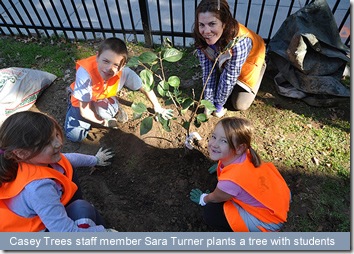
If you don’t know about Casey Trees, they are a  D.C.-based non-profit group  committed to restoring, enhancing and protecting the tree canopy of D.C. They plant trees,  teach other people about trees,  and work with elected officials, developers, and community groups to make sure that the population of trees in D.C. continues to grow forth and multiply. Ten years and over 10,000 trees since their beginning, it’s obvious to see that they DEFINITELY “dig” trees.

Jared Powell, Director of Communications and Development for Casey Trees helped me poll a few of their staff members to get some answers to the question “What is your favorite tree, and why?” Their answers reflect childhood memories, aesthetic admiration and respect for the environment that help to explain why Casey Trees is so devoted to helping Washington DC remain “The City of Trees.”

Native trees, which are generally better suited for the local environment, are marked with an (N)

Jared’s favorite tree: The eucalyptus, while not native to North America, has certainly made itself at home along the west coast particularly in California where I am from. Growing up, I would build forts at the base of these giants using its tessellated bark for roof materials, soak up its sweet scent emitted from its distinctive long, blue leaves and lounge in its shade on hot summer days. In short, the eucalyptus tree reminds me of home and a time when my only worry was when the end of recess bell would ring.

Marty O’Brien, COO: When I was growing up in Minneapolis in the late 1970s, there were many big and beautiful elm trees lining the boulevards in our neighborhood and throughout the city.  At some point the city came through and marked many trees with an orange “X” and soon removed all of those trees.  It drastically changed the character of the neighborhood and the city for the worse so, at about 10 years old, I realized for the first time the impact that trees could have.  We didn’t know what we had until it was gone.  So that is why I chose the American elm (N) as my favorite tree.  It was the first real connection I had with trees.

Mark DeSantis, Development Associate:  It’s not just the bursts of golden yellow leaves that dot D.C.’s streets during the fall that make the ginkgo my favorite tree – though in my opinion there are few things more beautiful to see in this city. For me it’s more their history and the fact that they’ve been around for so long that fascinate me. They are truly a relic from the past that has survived for so long – something few things in this world have managed. It’s this uniqueness that I find beautiful.

Oliver Pattison, Communications Associate: I am a fan of the pin oak (N)  because it is a great large-canopy street tree with a significant presence along certain D.C. streets. I know that oaks are not everyone’s favorite type of city tree because of concerns about falling acorns, but they more than make up for it with their beautiful fall foliage. I discovered that I liked pin oaks in particular by walking around Mount Pleasant and Kalorama Park in the fall.

Christopher Horn, Communications Associate: There are many species of oak in my home state of Kansas, but none like the willow oak (N). When I moved to D.C., I was not only amazed at how many trees there were, but also by the uniqueness of the willow oak. The tree has a dense canopy and its oblong willow-like leaves go from a bright green in spring to a beautiful yellow-orange in the fall. The willow oak is a sight to see in any season.

Sara Turner, Urban Forestry Manager: The artist in me loves sassafras (N)  for its color and three distinct leaf shapes, some simple others lobed, which make this tree's identification fun. I especially love the one shaped like a mitten resembling the state of Michigan, where I studied woody plants. In the fall, the leaves transition to striking hues of orange, red, and yellow. I am easily charmed by the spotting of Sassafras on a fall hike. 

Lisa Morris, Planning and Design Associate: Allentown, PA, where I’m from, has beautiful sycamore (N)  lined streets where the branches form an almost solid mass. These giant trees framed the streets I grew up on.

Michael Potts, GIS Specialist: The blackjack oak (N)  is a small, scrubby survivor, though one can grow very large if given proper resources. There are some small specimens at the top of Sugarloaf Mountain in Maryland, but I first came upon them as they grow natively on my family’s ranch in Texas. I loved taking walks through the forest populated by blackjacks and  post oaks. They always had a rugged appeal to me.

Tom Buckley, Director of Technical Services and Research: Having a favorite tree is a little like having a favorite ice cream.  I don’t think about it much.  But the Baobabs in Zimbabwe surprised me, as a little kid on safari.  You could crawl around inside them.  I had a tree-house, but this was a tree that could actually house you.  And they grew very large in dusty, dry climates

Rather than choosing one favorite tree, Shawn Walker, Urban Forestry Instructor, described the importance of following the practice of right plant/right place. In my opinion, right plant/right place is even more important than choosing natives. Choosing trees that are suitable for your property’s site conditions will generally require less water and less harmful chemicals – both of which are great for the local environment.

Shawn Walker: I chose “right tree, right place” because it’s kind of a theme around here: for a planted tree to thrive one must consider the site-specific constraints and chose a species thus suited – ‘right tree, right place’. When I came to work at Casey Trees a year ago, I was surprised that no other staff had chosen this as their favorite, so I nabbed it right away!

‘Right tree, right place’ describes a thoughtful approach to tree selection and landscape design but it also reminds us that there is room for our attitudes towards trees to be more nuanced, something more than simply ‘I like/dislike that tree’. Take the argument about native versus non-native species, for instance. I used to staunchly believe that native species should always be planted when possible. However, as I have become more aware of the threats to our urban forest from climate change and exotic pests, this bias has become somewhat murky. 

Our international trade patterns have resulted in the introduction of numerous harmful tree pests from Asia, and their potency as pests results from the fact that they are new invaders in a new land with few, if any, natural enemies to keep them in check. Of course, we should do what we can to control pests like the Emerald Ash Borer that continues its wholesale ash-murdering rampage but we can also take measures to make our urban forests more resistant to Asian pests by including Asian tree species within our palette.  The Manchurian Ash (Fraxinus mandschurica), to site a specific example, coevolved and shares native habitat with the Emerald Ash Borer, and it just so happens that it has a high degree of resistance to the pest. If we love ash trees and want to include them in our species composition, should we not consider the Manchurian Ash as one of many arrows in our quiver? Thus continues the ‘right tree, right place’ discussion…

Now that we’ve started digging, how about you. Do you have any favorite trees?

Website by Water Words That Work LLC